
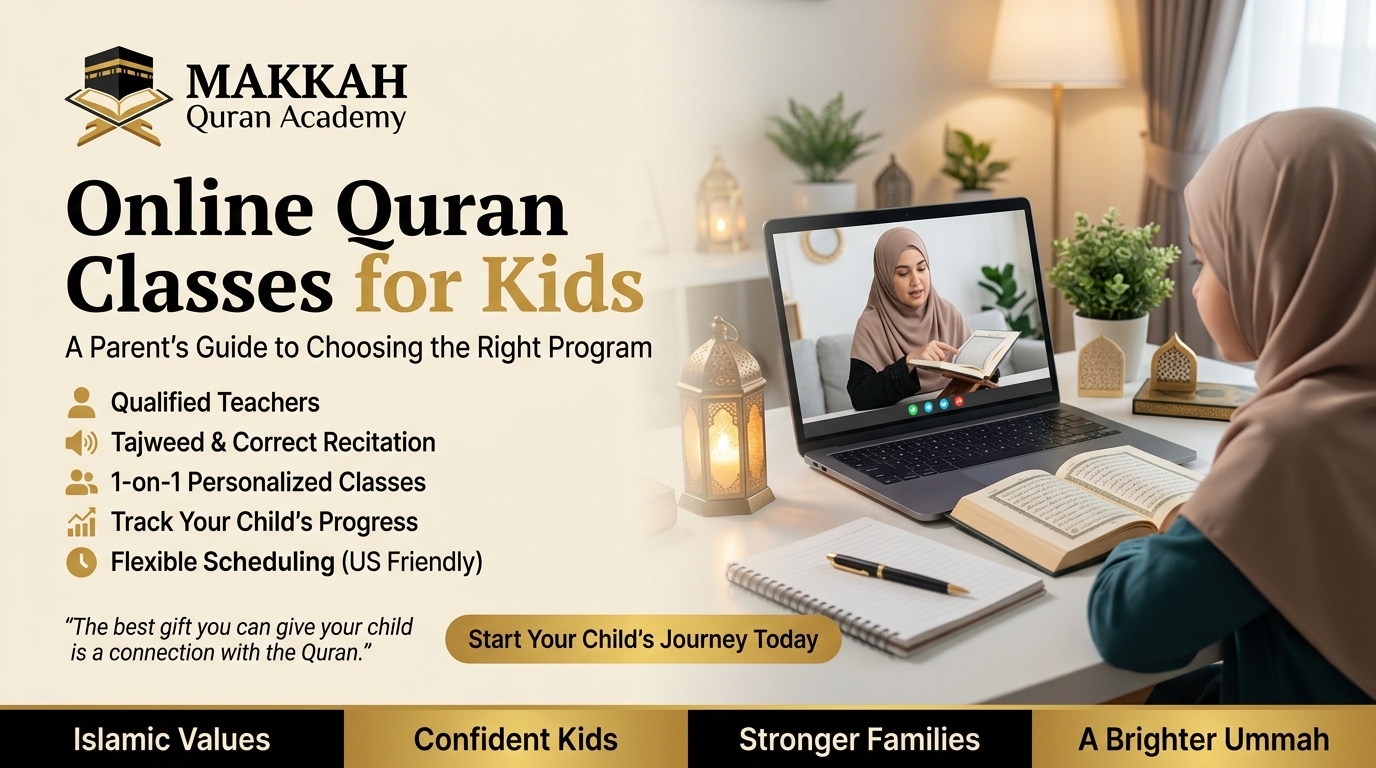
Finding the right online Quran classes for kids is about much more than choosing a convenient time on a calendar. A good Quran program should help your child read correctly, understand the basics of Tajweed, grow in confidence, and most importantly, build a positive relationship with the Book of Allah.
For Muslim parents in the USA and around the world, online learning can make consistent Quran education much easier. But with so many academies and tutors available, how do you know which program is actually right for your child?
This guide walks you through the most important things to look for before you enroll.
What Should Good Online Quran Classes for Kids Include?
Children do not all learn at the same pace. A strong program begins by understanding your child’s current level and then building a clear learning path around it.
Depending on the student, that path may include Arabic letters and pronunciation, Quran reading, Tajweed, memorization, and age-appropriate Islamic studies. The goal should not be to rush through pages. The goal is steady, correct progress that lasts.
1. Look for One-on-One Attention
Private lessons give a teacher the opportunity to hear every letter your child pronounces and correct mistakes immediately. This matters especially in Quran reading, where small pronunciation errors can become habits if they are repeated for months.
One-on-one teaching also allows the lesson to move at your child’s pace. A beginner may need more repetition, while an experienced reader may need focused work on Tajweed and fluency.
2. Choose a Teacher Who Knows How to Teach Children
Knowing Quran is essential, but teaching children is a skill of its own. A child-friendly Quran teacher should be patient, encouraging, clear, and able to keep a young learner involved without turning every lesson into pressure.
Parents should look for teachers who correct mistakes gently, celebrate progress, and adjust their approach when a child is struggling. A child who feels comfortable with the teacher is more likely to participate, practise, and stay consistent.
3. Make Tajweed Part of the Learning Journey
Tajweed should not feel like a list of complicated rules that children must memorize before they can enjoy reading. Good teaching introduces correct pronunciation and recitation gradually, through practice and repetition.
If your child is ready to develop stronger recitation skills, explore our Quran Reading with Tajweed for Kids program.
4. Make Sure the Schedule Works for Your Family
Consistency is one of the biggest factors in Quran learning. The “best” teacher is not very useful if the class time constantly conflicts with school, homework, activities, or family commitments.
Online lessons can be particularly helpful for families in different time zones because they remove travel time and make it easier to build Quran into the weekly routine. Choose a schedule your child can realistically maintain.
5. Decide Whether Your Child Needs Reading, Tajweed, or Hifz
Not every child should start in the same place. A complete beginner may need to strengthen Arabic letters and sounds first. A child who already reads may need Tajweed and fluency. Another student may be ready for structured memorization.
For children beginning a memorization journey, see our Quran Memorization program. Students who need broader language foundations can also explore our Arabic learning program.
6. Look for Progress You Can Actually See
Parents should know what their child is learning. Ask simple questions: What is my child working on now? What mistakes are being corrected? What should we practise between lessons? What is the next milestone?
A structured program should make progress understandable instead of leaving parents wondering whether months of classes are producing results.
Online Quran Classes vs. Traditional In-Person Lessons
Both can work well. The advantage of online Quran classes is flexibility and access. Families are no longer limited to teachers who live nearby, and children can learn from home without adding another commute to an already busy week.
The important question is not simply whether the lesson is online or in person. It is whether the teaching is personal, consistent, accurate, and appropriate for your child.
How Often Should Kids Take Quran Classes?
There is no single schedule that fits every family. In general, shorter and more consistent lessons are often easier for children to maintain than occasional long sessions. The right frequency depends on your child’s age, attention span, current level, and goals.
For Hifz, frequent revision becomes especially important. For beginners, consistency helps letters, sounds, and reading patterns become familiar. The best plan is one your family can sustain without making Quran time feel like a burden.
Questions to Ask Before Enrolling Your Child
- Will my child receive individual attention?
- Does the teacher have experience teaching children?
- How will Tajweed and pronunciation be corrected?
- Can the program adapt to my child’s current level?
- Are the class times practical for our time zone and school schedule?
- How can parents follow the child’s progress?
- Can we try a lesson before committing?
What Age Should a Child Start Learning Quran?
There is no perfect age that applies to every child. Some children are ready to become familiar with Arabic letters and short surahs at a young age, while others progress better when formal lessons begin later. Readiness, attention span, and the quality of the learning experience matter more than racing to start.
The early goal should be positive familiarity and consistency. As the child grows, lessons can become more structured and focused on accurate reading, Tajweed, memorization, and understanding.
Frequently Asked Questions
Can a complete beginner learn Quran online?
Yes. A beginner can start with Arabic letters, sounds, and basic reading before gradually progressing to Quran recitation. The program should be matched to the student’s starting level.
Are online Quran classes effective for children?
They can be very effective when lessons are live, interactive, consistent, and adapted to the child. Teacher quality and individual attention matter more than simply putting a child in front of a screen.
Should my child learn Tajweed from the beginning?
Correct pronunciation should be encouraged from the beginning, while detailed Tajweed rules can be introduced gradually according to the child’s ability and reading level.
Can my child study Quran and Islamic Studies together?
Yes. Many families want their children to build both recitation skills and Islamic knowledge. You can explore our Islamic Studies program alongside Quran learning.
Give Your Child a Stronger Start with the Quran
The right Quran teacher can do more than improve pronunciation. With patient guidance, a clear plan, and consistent practice, your child can develop confidence in reading and a relationship with the Quran that continues far beyond the classroom.
At Makkah Quran Academy, we help students learn through personalized online instruction in Quran reading, Tajweed, memorization, Arabic, and Islamic Studies.
Want to find the right starting level for your child? Register for a trial and speak with our team about the learning path that fits your child.